
Table of Contents
- Why Your Business Portrait Decides the First Impression
- The Benefits of Professional Branding Photos for Your Online Presence
- What to Wear for Corporate Headshots: Getting the Details Right
- A Professional Headshot Posing Guide for Natural Results
- Choosing Backgrounds and Image Formats for Each Platform
- Common Mistakes That Make a Business Portrait Look Dated
- How Often to Update Your Business Portrait
- Frequently Asked Questions
Last Updated: September 13, 2026
Why Your Business Portrait Decides the First Impression
Your business portrait is often the first thing a client, casting director or recruiter sees, and it forms their judgement before they read a single word about you. In this guide from Neil Taylor Photography, we break down how to make your business portrait stand out online, from what you wear to how you pose and where you use the final image.
A business portrait is a purpose-built photograph of you at work: framed, lit and cropped so it reads clearly at the small sizes screens actually display. Unlike a casual snap, it is designed to communicate competence and warmth in the half-second someone spends scanning a profile.
That half-second matters more than most people admit. A dated or poorly lit photo quietly undermines an otherwise strong profile, while a sharp, current one does the opposite: it earns trust before you have said anything. Below, we cover the choices that separate a portrait that works from one that simply fills space.
The Benefits of Professional Branding Photos for Your Online Presence
The benefits of professional branding photos come down to consistency and credibility. When your website, LinkedIn profile and marketing materials all show the same well-made image, you look established rather than improvised.
A few practical gains stand out:
- Recognition. A consistent portrait makes you easier to remember across platforms.
- Trust. Visitors judge a site’s credibility partly on how polished its people photos look.
- Flexibility. A professional session gives you several crops, not one rigid shot.
- Longevity. Proper lighting and editing mean the image holds up for years.
What most guides miss is that a branding photo is not just a headshot. It is a small library of images you can pull from for different purposes. Neil Taylor Photography builds that range into studio and on-location sessions, so you leave with options rather than a single frame.
What to Wear for Corporate Headshots: Getting the Details Right
Knowing what to wear for corporate headshots removes most of the stress before you arrive. The short answer: choose solid, mid-tone colours that suit your industry, and avoid anything that distracts from your face.
Colours and Patterns That Work on Camera
Solid colours photograph cleanly and keep attention on you. Mid-tones such as navy, charcoal, burgundy and forest green flatter most skin tones. Pure white can blow out under bright lights, and busy prints, thin stripes and tight checks tend to shimmer or blur on camera. If you want a pattern, keep it bold and simple.
Book your headshot session today →
Grooming, Hair and Accessories
Grooming shows up more in a portrait than in daily life. Neat hair, tidy nails and a fresh shave or shaped beard all read as care. Keep jewellery minimal: small, quiet pieces work, while large or reflective items catch the light. The same goes for glasses, which can reflect studio lighting, so mention them when you book.
Bring two or three outfit options to your session. A quick change mid-shoot often produces the one frame you end up using everywhere, and it costs you nothing but a few minutes.
A Professional Headshot Posing Guide for Natural Results
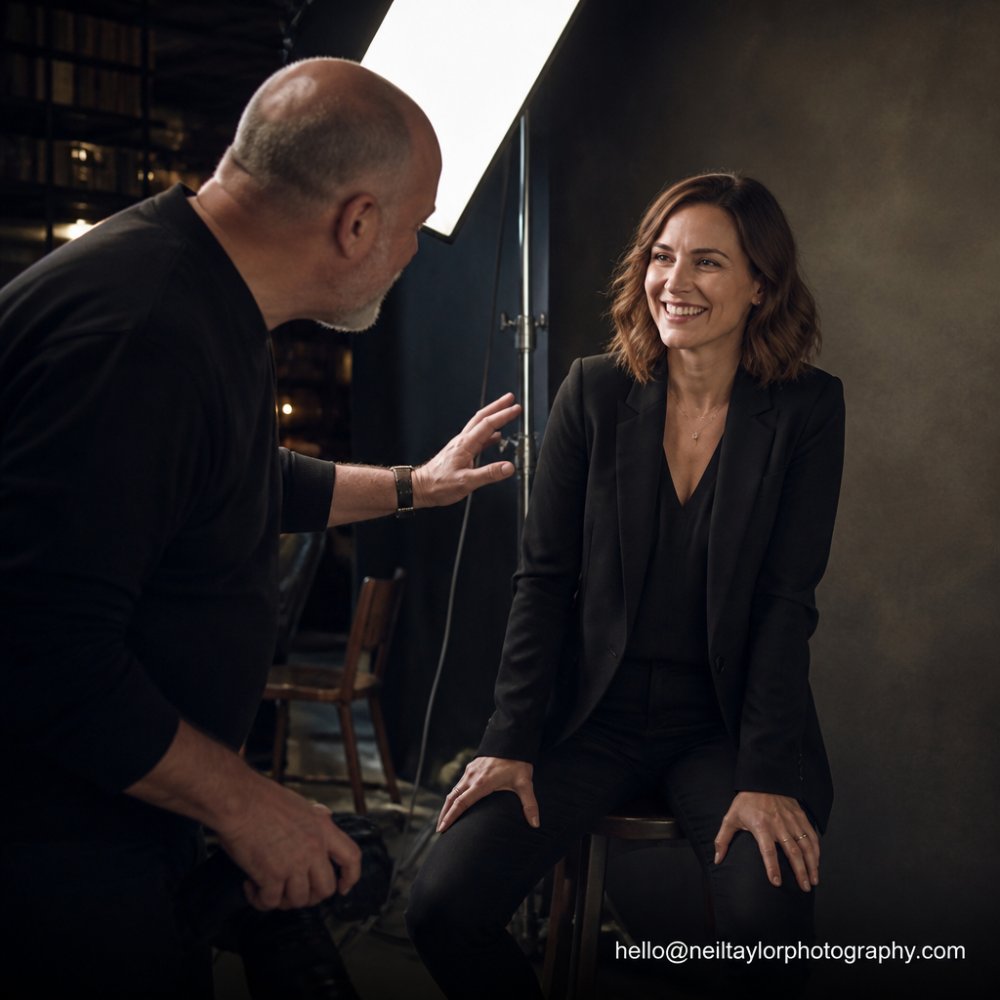
A professional headshot posing guide starts with one principle: give the body something to do. Stiffness comes from standing still and waiting, so a good photographer keeps you talking and moving between frames.
Posture, Angle and Where to Look
Stand tall with relaxed shoulders, then turn slightly so your body sits at an angle to the camera rather than square-on. That slight turn slims the frame and looks less like a passport photo. For your gaze, look just off the lens or directly into it, depending on whether you want approachable or authoritative.
A common mistake is over-posing: the chin jutting forward, the fixed grin held too long. Natural results come from conversation, not commands. Neil Taylor Photography works this way on purpose, guiding you into position while you talk, so the expression is genuine rather than performed.
Choosing Backgrounds and Image Formats for Each Platform
Background and format should match where the image will live. A neutral studio backdrop suits LinkedIn and company pages, while an on-location setting can add context for a website’s about page.
| Platform | Best Crop | Background | Format |
|---|---|---|---|
| Head and shoulders | Neutral, uncluttered | Square or 4:5 | |
| Website team page | Head to mid-chest | Studio or office | Landscape or square |
| Speaker bio | Head and shoulders | Simple, professional | Square |
| Social profiles | Tight head shot | Plain, high contrast | Circle-safe |
Keep the subject clear of the edges, since circular profile crops cut into corners. A photo that looks generous on a website can lose its head in a circular frame if it was not composed with that in mind.
Common Mistakes That Make a Business Portrait Look Dated
The fastest way to date a portrait is to leave it untouched for years. Clothing, hairstyles and editing trends all age, and a photo that felt current a decade ago now reads as a time capsule.
Other frequent errors:
Book your headshot session today →
- Heavy filters or over-editing. Skin that looks plastic signals an old editing style.
- Low resolution. Blurry or pixelated images look careless when enlarged.
- Busy backgrounds. Clutter competes with your face and muddies the frame.
- Harsh shadows. Uneven lighting hides expression and adds years.
- Wrong crop. A full-body shot shrunk to a thumbnail loses your face entirely.
Using a photo more than a few years old is the single most common mistake. If your appearance has changed and the image has not, viewers notice the mismatch and trust the profile less.
How Often to Update Your Business Portrait
Most professionals should refresh a business portrait every two to three years, or sooner if their appearance, role or industry has shifted. Actors and public-facing professionals often update more frequently, since casting and media work depend on an accurate, current likeness.
The trigger is not the calendar alone. If you have changed your hair, glasses, weight or overall look, or if you have moved into a more senior role, the photo is due for an update. A portrait that no longer matches the person turning up to the meeting creates a small but real disconnect.
When you do update, keep the shoot efficient by arriving with your outfits chosen and your questions ready. Neil Taylor Photography offers both studio and on-location sessions, so you can match the setting to how you actually want to be seen. You can review current options and professional headshot guidance from the major professional networks before you book.
A strong business portrait is not about looking perfect. It is about looking like the credible, current version of yourself, and that takes a little planning before the shutter clicks. If your current photo no longer does that job, Neil Taylor Photography can help with casting-ready actor headshots, personal branding portraits and consistent corporate photography for your team, all shot in studio or on location. Check Availability or email hello@neiltaylorphotography.com to arrange your session.
Frequently Asked Questions
What makes a good business portrait?
A good business portrait shows you clearly, looks like you on a normal working day, and matches the platform it appears on. Sharp focus, even lighting and a simple background matter more than dramatic styling. Expression carries the most weight: a relaxed, approachable look builds trust faster than a stiff corporate stare. Clothing should suit your industry without distracting from your face, and the crop should keep your eyes near the top third of the frame so it works in small circular profile images.
How often should you update your business portrait?
Most professionals should refresh their portrait every two to three years, or sooner if your appearance changes noticeably. A new haircut, glasses, significant weight change or a shift in your role all justify an update. If your portrait no longer looks like you when you meet clients in person, it is overdue. Keeping it current avoids the awkward gap between your online image and your actual appearance, which matters most on platforms like LinkedIn where people check your photo before meetings.
Should I use a professional photographer for my LinkedIn profile picture?
A professional session gives you controlled lighting, a clean background and guidance on posing, which phone photos rarely match. That said, the benefits of professional branding photos go beyond one image: you get a consistent set for your website, proposals and social profiles. If budget is tight, prioritise a single strong headshot over several weaker ones. Check a photographer’s portfolio for clients in your sector before booking.
How do I look more approachable in my business headshot?
Approachability comes from the eyes and mouth, not the pose. Try a genuine smile by thinking of something specific that amuses you rather than holding a fixed grin. Ask your photographer to shoot a few frames mid-conversation, since talking naturally relaxes the face. Tilting your chin slightly down and forward defines the jaw without looking aggressive. Avoid folding your arms or squaring your shoulders directly at the lens, and keep your hands occupied if you tend to fidget, for example resting one on a lapel.