Table of Contents
- What to Wear for Professional Headshots: Key Principles
- Best Colours for Headshots Based on Skin Tone
- Corporate Headshot Attire: Structured Blazers and Professional Necklines
- Headshot Outfit Ideas: Men’s and Women’s Styling
- What to Avoid: Patterns, Logos and Distracting Elements
- Accessories and Jewellery Guidelines for Camera-Ready Headshots
- Headshot Preparation Guide: Virtual vs. In-Person Considerations
- Personal Branding vs. Corporate Headshots: Tailoring Your Look
Last Updated: July 28, 2026
What to Wear for Professional Headshots: Key Principles
Your clothing either frames your face and conveys competence, or it competes with you for attention. At Neil Taylor Photography, we’ve worked with hundreds of actors, entrepreneurs, and business professionals, and wardrobe choice is the single biggest factor separating average headshots from casting-ready, LinkedIn-worthy images.
The most overlooked rule: your clothing should make people look at YOUR FACE, not your outfit. Solid colours, proper fit, and minimal distractions are non-negotiable.
Professional headshots are cropped tightly, capturing roughly from your shoulders up. A jacket that’s too loose will bunch around your neck; one that’s too tight will create unflattering wrinkles. Tailoring isn’t a luxury, it’s the foundation of every strong headshot.
Why Clothing Choices Matter More Than You Think
For actors, a well-chosen headshot outfit can be the difference between getting called in for an audition or being passed over. For entrepreneurs and business professionals, your headshot appears on LinkedIn, your website, or company team pages, where first impressions shape how clients perceive you. Research shows visual appearance influences trust and credibility judgments in seconds. Professional headshots live for years across multiple platforms, so your wardrobe choice needs to feel timeless, not trendy. Solid colours in neutral and jewel tones age far better than bright neons or bold patterns.
How Fit and Tailoring Impact Your Professional Image
Fit is where most people go wrong, and it’s fixable. A well-fitted garment instantly elevates your appearance; poor fit does the opposite.
Here’s what to look for:
- Shoulders: The seam should sit right at your shoulder point
- Chest: The jacket should close without pulling or gaping
- Length: Blazers should end at your hip bone
- Sleeves: Should end at your wrist bone, allowing a quarter-inch of shirt cuff to show
- Back: No horizontal wrinkles or pulling
If your off-the-rack garment doesn’t fit perfectly, invest in tailoring. A £30 blazer tailored to fit you perfectly will look better than a £200 blazer that doesn’t. Most alterations cost £20-£60 and take one to two weeks.
Professional fit is non-negotiable for headshots. A single ill-fitting garment will be visible in close-up photography and will undermine even the best hair and makeup.
Best Colours for Headshots Based on Skin Tone
Certain colours make your skin appear brighter and more photogenic. Your skin undertone, warm, cool, or neutral, determines which colours work best. To identify your undertone, check the veins on your wrist in natural light. Greenish veins indicate warm undertones; bluish or purple indicate cool undertones; both equally suggest neutral.
Understanding Colour Theory for Your Complexion
Studio lighting is typically daylight-balanced (around 5500K), which is cool-toned. This means cool colours often photograph more vividly under studio lights, while warm colours can appear slightly muted.
Recommended Palettes: Navy, Charcoal, Burgundy and Emerald Green
Charcoal grey is arguably the safest choice. A true charcoal creates excellent contrast with most skin tones, photographs neutrally, and conveys professionalism without being as formal as black.
Navy blue is similarly reliable and slightly warmer than charcoal. It reads as corporate and trustworthy and complements many skin tones.
Burgundy works particularly well for warm undertones or those wanting something more distinctive than grey or navy. A deep, true burgundy photographs richly and can make your skin appear warmer and more vibrant.
Emerald green suits cool-toned complexions exceptionally well and photographs with remarkable depth. A true emerald creates a sophisticated, memorable look without being distracting.
For all four colours, saturation matters. A muted, jewel-toned version photographs better than a bright, highly saturated one.
Avoid pure black for headshots unless you’re going for a very formal, editorial look. Pure black can create harsh shadows under studio lighting. Charcoal grey achieves the same formal effect without the downsides.
Corporate Headshot Attire: Structured Blazers and Professional Necklines
Corporate headshots demand a different approach than creative industry headshots. Your outfit should communicate authority, competence, and trustworthiness. A structured blazer is the foundation of nearly every effective corporate headshot.
Choosing the Right Blazer Fit and Fabric
Choose a blazer in a solid colour from the recommended palette: charcoal, navy, burgundy, or emerald. The fabric should be a natural blend, wool, wool-blend, or linen-blend, that photographs well and holds structure. Avoid thin, flimsy fabrics or shiny synthetics that create unwanted reflections. The fit is critical: shoulders should sit precisely at your shoulder point, the chest should close without pulling or gaping, length should end at your hip bone, and sleeves should end at your wrist bone, allowing a quarter-inch of shirt cuff to show. If your blazer doesn’t fit perfectly off the rack, get it tailored.
Necklines That Frame Your Face and Convey Authority
The neckline frames your face and is arguably the most visible element in a headshot.
For women, effective necklines include:
- Jewel neckline (round, high): creates a clean frame
- Boat neckline (horizontal, wide): elongates the neck
- V-neckline (modest): creates visual length
- Turtleneck (under a blazer): creates a clean, professional line
For men, wear a collared shirt under your blazer. White, light blue, or subtle pattern shirts work well. The collar should sit neatly without bunching or gapping.
If you’re wearing a blazer, unbutton it slightly before the shot. This creates a more relaxed, approachable look while maintaining professionalism.
Headshot Outfit Ideas: Men’s and Women’s Styling
Men’s Professional Headshot Attire
Option 1: Blazer and Dress Shirt (Most Corporate)
- Charcoal, navy, or burgundy blazer, tailored to fit
- White, light blue, or subtle-pattern dress shirt
- No visible jewellery except a simple watch
Option 2: Blazer and Casual Shirt (More Approachable)
- Navy or charcoal blazer, tailored to fit
- Solid-colour casual shirt in white, light blue, or subtle grey
- Open collar, no tie
Option 3: Structured Sweater (Creative Industries)
- Charcoal, navy, or emerald structured sweater with a defined fit
- Optional: unstructured blazer over the top
Ensure your shirt fits well in the neck and shoulders. A shirt that’s too tight will create pulling and wrinkles; one too loose will bunch.
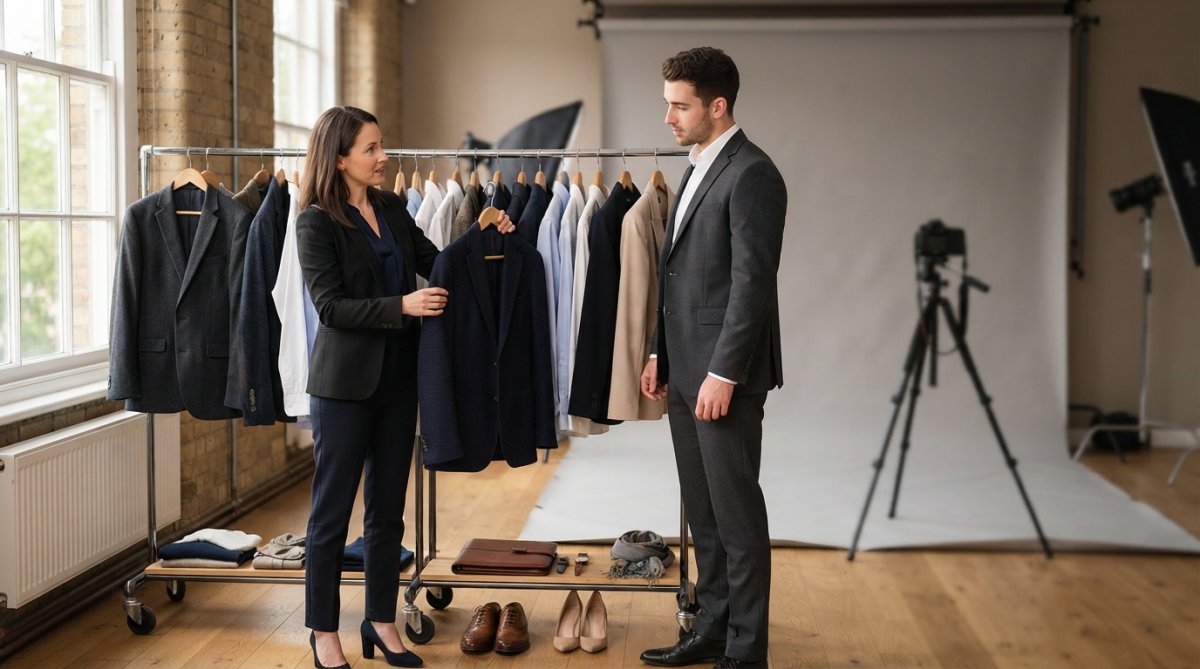
Women’s Professional Headshot Attire
Option 1: Blazer and Blouse (Most Corporate)
- Charcoal, navy, burgundy, or emerald blazer, tailored to fit
- Solid-colour blouse in white, cream, light blue, or a complementary colour
- Jewel, boat, or modest V-neckline
- Minimal jewellery
Option 2: Structured Dress with Blazer (Polished)
- Solid-colour structured dress in charcoal, navy, burgundy, or emerald
- Matching or complementary blazer
- Professional neckline
Option 3: Structured Top Without Blazer (Creative Industries)
- Solid-colour structured top in charcoal, navy, burgundy, or emerald
- Neckline that frames your face
- Minimal jewellery
Ensure your top or dress fits properly through the shoulders and chest.
What to Avoid: Patterns, Logos and Distracting Elements
Knowing what to avoid is equally critical as knowing what to wear.
Why Bold Patterns and Bright Colours Distract From Your Face
Patterns, stripes, checks, and small prints create visual noise. When someone looks at your headshot, their eye bounces across the pattern instead of settling on your face. Certain patterns can create moiré effects under studio lighting, shimmering or vibrating in photographs. Bright colours, neon pink, electric blue, lime green, compete with your face for attention. Your face should be the focal point. Very light colours (bright white, cream) can also be problematic, creating a blown-out, washed appearance in close-up photography under studio lighting.
Logo-Free Clothing and Visual Hierarchy Rules
Logos, brand names, or visible text on your clothing are absolute no-gos. A visible logo immediately dates your image and creates a secondary focal point that competes with your face. Choose plain, logo-free garments. The principle is visual hierarchy: your face should be the clear focal point. Everything else should support that hierarchy, not compete with it.
Avoid anything with visible logos, brand names, or distinctive patterns. Even a small designer logo can distract from your face and make your headshot feel like an advertisement rather than a professional image.
Accessories and Jewellery Guidelines for Camera-Ready Headshots
Accessories and jewellery can enhance a professional headshot if chosen carefully. The rule is simple: less is more.
Simple Accessories That Enhance Without Overwhelming
For men, a simple, classic watch is appropriate. Avoid chunky bracelets, multiple rings, or visible chains.
For women, a simple watch is also appropriate. A delicate bracelet on one wrist can work if it’s subtle. Avoid anything that jingles, catches light, or draws attention.
For both genders, avoid visible piercings beyond simple ear piercings. For creative industries, visible piercings are often fine. For traditional corporate environments, they can sometimes distract.
Jewellery That Photographs Well Under Studio Lighting
Choose pieces with matte finishes. A matte gold or silver piece will look polished without creating harsh reflections under studio lights.
For women, simple stud earrings or small hoop earrings work well. A delicate pendant necklace can work if it’s simple and sits close to your body. Avoid long, dangling earrings or statement necklaces that don’t photograph well in headshots.
Jewellery should enhance, not distract. Choose simple, matte-finish pieces that complement your outfit without drawing attention away from your face.
Headshot Preparation Guide: Virtual vs. In-Person Considerations
Professional headshots exist in two contexts: in-person studio sessions and virtual headshots taken for online platforms. Wardrobe considerations differ slightly between the two.
Dressing for Studio Sessions Versus On-Location Shoots
For in-person studio sessions at a professional photography studio, you have complete control over the environment. Follow all the guidelines above: solid colours, proper fit, tailored garments, minimal jewellery.
For on-location shoots, photographed at your office or outdoors, you have less control over lighting and background. Stick to the safest colour choices: charcoal, navy, or burgundy. Ensure your outfit is pristine and wrinkle-free. Your clothing needs to create clear contrast and separation from the background.
Virtual Headshot Attire: What Works on Camera Versus In Person
Virtual headshots, photographed via video call for LinkedIn or Zoom profiles, have unique considerations. The same colour principles apply: solid, jewel-toned colours photograph best. A structured blazer or top helps create definition around your shoulders and neck. Avoid very loose or oversized clothing.
Lighting is critical. Position yourself facing a window with natural light, or use a small ring light positioned just above your camera. Avoid overhead lighting, which can create unflattering shadows.
For virtual headshots, test your appearance on camera before the actual session. Colours can shift in video, and what looks good in person might appear different on camera. Adjust lighting or clothing as needed.
Personal Branding vs. Corporate Headshots: Tailoring Your Look
Not all professional headshots are the same. Your industry, role, and personal brand all influence what you should wear.
Building Your Colour Palette Around Your Industry
Consider your industry’s norms. Corporate finance typically calls for conservative colours: charcoal, navy, burgundy. Creative industries allow more boldness: emerald, jewel tones, slightly more personality. Tech and startup culture often embraces more casual, approachable looks. Think about where your headshot will appear and dress appropriately for that context.
Balancing Authenticity With Professional Expectations
You want your headshot to feel authentically like you, but you also want it to meet professional expectations for your industry. Find the intersection between your personal style and your industry’s norms. If you typically wear bright colours and patterns in your daily life, wearing a solid navy blazer might feel inauthentic; choose a jewel-toned colour (emerald, burgundy) that feels more like you while still being professional.
Your headshot should make people who know you think, "Yes, that’s exactly how I’d describe them." For actors, your headshot should represent the types of roles you’re likely to book. For entrepreneurs and business professionals, your headshot should convey both professionalism and approachability.
Your headshot should feel authentically like you while meeting your industry’s professional expectations. The best headshots feel like the professional, polished version of yourself, not a completely different person.
Summary: What to Wear for Professional Headshots
Choose solid, jewel-toned colours that complement your skin tone; ensure everything fits perfectly; keep necklines professional and face-framing; avoid patterns, logos, and distracting elements; and select minimal, tasteful jewellery.
The colours that work best are charcoal, navy, burgundy, and emerald green. Fit is non-negotiable, invest in tailoring if needed. A perfectly fitted charcoal blazer will outperform an expensive, poorly fitting one.
Avoid patterns, bright colours, logos, and anything that competes with your face for attention. Your face is the focal point. Everything else should support that hierarchy.
| Element | Best Choice | Why It Works |
|---|---|---|
| Colour | Charcoal, navy, burgundy, emerald | Photographs well, conveys professionalism, complements most skin tones |
| Fit | Tailored to your body | Creates clean lines, frames your face, photographs clearly |
| Neckline | Jewel, boat, or modest V | Frames your face, professional appearance |
| Patterns | None, solid colours only | Avoids visual noise, keeps focus on your face |
| Jewellery | Simple, minimal pieces | Enhances without distracting |
| Fabric | Natural blends, medium weight | Drapes well, photographs clearly, holds structure |
The investment in getting your headshot wardrobe right pays dividends. A professional, polished headshot creates a powerful first impression and opens doors for auditions, builds trust with clients, and elevates your professional image across every platform where it appears.
Creating a powerful professional headshot starts with understanding what to wear. Most professionals don’t get a second chance to make a first impression, and your headshot is often that first impression. When you combine the right wardrobe, solid colours, proper fit, professional necklines, minimal distractions, with professional photography, you create an image that works for you for years.
At Neil Taylor Photography, we work with actors, entrepreneurs, and business professionals who understand that their headshot is an investment in their career. We guide clients through wardrobe selection, ensure proper fit and tailoring, and capture images that feel authentically like them while meeting professional standards.
Book your headshot session with Neil Taylor Photography and create the professional image that opens doors and builds trust with your audience.
Frequently Asked Questions
What colours are best to wear for a professional headshot?
Solid colours work best for professional headshots. Navy blue, charcoal, burgundy and emerald green are excellent choices that photograph well under studio lighting. Your best colour depends on your skin tone, warmer complexions suit warm jewel tones, whilst cooler skin tones look striking in cool neutrals. Avoid bright neons or busy patterns that distract from your face. The goal is to create visual hierarchy where your face remains the focal point.
Should I wear a blazer for professional headshots?
A structured blazer is ideal for corporate headshots and formal professional images. It conveys authority and creates a polished, camera-ready appearance. Ensure the blazer fits properly at the shoulders and is tailored to your frame, oversized jackets look unprofessional. For personal branding or creative industries, a blazer is optional but recommended. Always choose solid colours over logos or patterns to maintain focus on your face.
What should I avoid wearing for professional headshots?
Avoid bold, distracting patterns, bright colours, and clothing with logos or text. Oversized or poorly fitted garments undermine your professional image. Skip trendy pieces that will date quickly, solid, timeless pieces are better investments. Avoid necklaces that create visual clutter, and steer clear of shiny jewellery that reflects studio lighting harshly. Distraction-free clothing keeps attention on your face and expression, which is essential for a successful headshot.
How important is fit and tailoring for professional headshots?
Fit is critical. Poorly tailored clothing makes even expensive pieces look cheap and undermines your professional image. Well-fitted garments create clean lines, flatter your body, and photograph better under studio lighting. Invest time in tailoring, a few adjustments to shoulder seams, sleeve length and jacket waist can transform how you appear on camera. Proper fit also boosts your confidence, which translates to more natural, engaging expressions in your headshots.
This article was written using GrandRanker