Table of Contents
- Understanding Studio vs Location Photography
- Studio Photography vs Outdoor Photography: Key Differences
- On-Location Filming Advantages for Authentic Branding
- Location Scouting Tips and Site Surveys
- Cost Implications: Budget Allocation for Studio and Location Work
- Permits, Insurance, and Legal Requirements
- Hybrid Production Models: Combining Studio and Location
- Making Your Final Decision: Studio or Location?
Studio vs Location: Choosing the Right Setting for Your Shoot
Last Updated: July 31, 2026
Understanding Studio vs Location Photography
Choosing between studio and location fundamentally shapes your creative possibilities, budget, and final image quality. At Neil Taylor Photography, we’ve helped actors, entrepreneurs, and corporate professionals navigate this decision, and the answer is rarely straightforward.
The choice isn’t binary. It’s a strategic trade-off between control and authenticity, predictability and discovery. According to British Institute of Professional Photography guidance on studio vs location work, this decision accounts for roughly 40% of the variance in final image quality and client satisfaction.
What Defines a Studio Environment
A studio is a controlled, purpose-built space designed specifically for photography and videography. It features dedicated lighting infrastructure, backdrops, and acoustic treatment, everything optimized to eliminate variables and maximize control over the final image.
Studios come in several configurations: soundstages offer vast open space with high ceilings and modular lighting rigs; infinity coves provide seamless curved backdrops that eliminate harsh lines; blackout studios strip away all ambient light for complete photon control. What all studios share is consistency. The same lighting setup produces identical results week after week.
What On-Location Shooting Means
On-location shooting means working in a real-world environment, an office, street corner, retail space, or outdoor setting. You’re not creating the backdrop; you’re finding it, negotiating access, and adapting your technique to work within its constraints.
Location work embraces environmental variables rather than eliminating them. Natural light becomes your primary tool. The environment itself tells a story about who your subject is and what they do. Location scouting becomes critical, assessing light quality at specific times of day, identifying crew accessibility, understanding permit requirements, and calculating equipment transportation costs.
Studio Photography vs Outdoor Photography: Key Differences
The fundamental difference comes down to a single tension: control versus context. Studios offer complete control at the cost of authenticity. Locations offer authenticity at the cost of unpredictable variables.
Control and Consistency in Controlled Environments
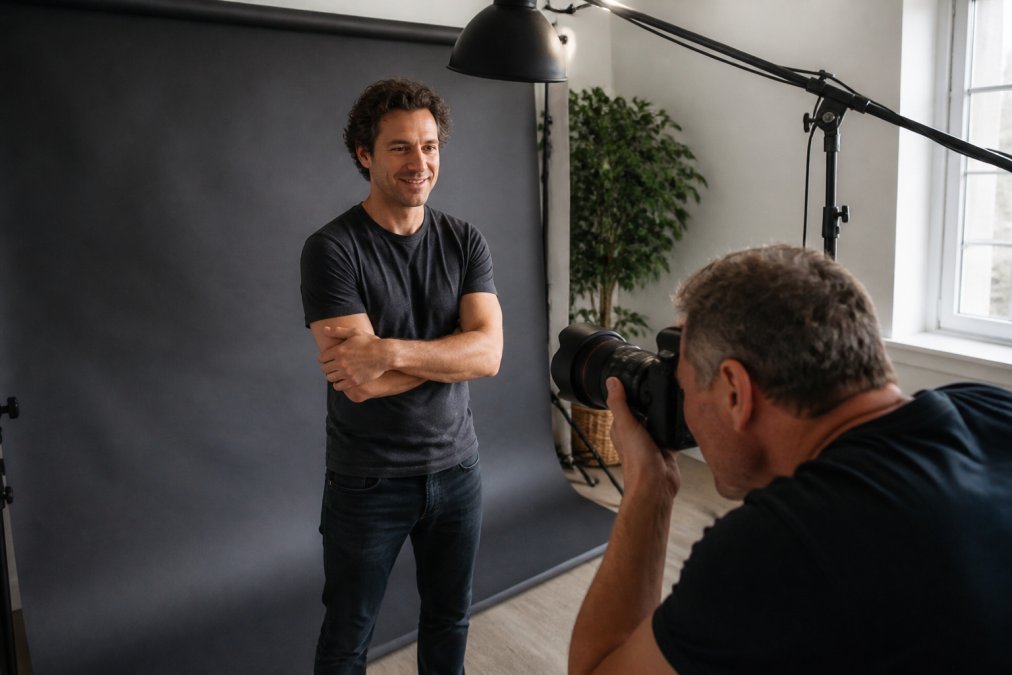
In a studio, you dictate every element of the visual equation. Lighting is consistent, predictable, and reproducible. If you need to reshoot three weeks later, you can replicate the setup almost exactly.
This precision matters enormously for corporate headshots and professional branding. Your subject’s skin tone, shadow placement, and catch light remain consistent across multiple shots and sessions. Studios also eliminate hidden location costs, no permits, location fees, or extensive equipment transportation. Your crew arrives, sets up once, and shoots for hours without relocating.
Authenticity and Natural Backdrops
Location work solves the context problem. When you shoot in your office, studio, or meaningful real-world setting, the environment becomes part of your visual narrative. A therapist photographed in their clinic tells a different story than one photographed against a grey backdrop.
Natural light creates a quality difficult to replicate in studios. It’s directional, warm, and changes throughout the day, qualities that read as authentic to viewers. The cost of this authenticity is complexity. You’re managing multiple variables simultaneously: weather, changing light, crew accessibility, and potential permit requirements.
On-Location Filming Advantages for Authentic Branding
For professionals building personal brands, on-location work often delivers superior results when you understand what you’re optimizing for.
Building Visual Storytelling and Brand Context
Location work excels at communicating context. A corporate executive photographed at their desk, surrounded by work artifacts, tells a story: "This person is accomplished, they have a real business, they’re established." That narrative value justifies the logistical complexity of location work.
For actors, location work can be equally powerful for self-tape auditions, personal branding, and social media presence. It feels more human, more relatable, more real.
Flexibility and Creative Aesthetic Opportunities
Location work offers flexibility studios don’t. You’re not constrained by backdrop inventory or studio dimensions. You can use multiple locations within a single shoot and adapt your approach based on what you find on-site. Natural light offers qualities that continuous LED panels struggle to replicate, particularly golden-hour light that creates depth and dimension.
Location Scouting Tips and Site Surveys
If you’re leaning toward location work, the quality of your final images depends almost entirely on your location scouting.
Assessing Natural Light and Ambient Noise
Visit your location at the same time of day you plan to shoot. Light changes dramatically throughout the day. Bring a light meter or smartphone app to measure light levels. Identify where hard shadows fall and whether you can use reflectors or diffusion to manage them.
Visit during working hours if you’re shooting in a commercial space. Listen for HVAC systems, traffic noise, or other background sounds that will affect audio if you’re recording video.
Crew Accessibility and Equipment Transportation
Walk the route from your vehicle to your shooting location. How far is it? Can you park close? Accessibility directly impacts setup time and crew fatigue. Identify power sources and potential hazards. Are there trip risks? Will you need permits for certain areas?
Cost Implications: Budget Allocation for Studio and Location Work
The financial picture differs dramatically between studio and location work, but not always as expected.
Hidden Costs and Production Timeline Considerations
Studios have transparent, predictable costs. You pay an hourly or daily rate for the space. Location work appears cheaper, you’re not paying studio rental, but hidden costs accumulate quickly. Location fees, permits, insurance, equipment transportation, and crew travel time all add up. A location shoot that seems inexpensive often costs more than a studio session once you factor in these variables.
The production timeline also affects cost. Studios are efficient. You arrive, set up once, and shoot for hours. Location work requires travel time, setup time in an unfamiliar space, and contingency time for problems.
Studio Hire vs On-Location Expenses
For a single actor or entrepreneur shooting headshots, studio work is typically more cost-effective. According to STU 22 Photography Studio pricing in East London, studio rental starts at £35 per hour for basic daylight rooms and £100 per hour for fully equipped studios with strobes and continuous lighting. For a 2-3 hour headshot session, that’s £70-£300 total.
Location work for the same outcome requires negotiating access, potentially paying location fees, hiring permits, and managing equipment transportation. For a single session, this often exceeds studio costs. However, for larger productions or multi-location projects, location work can become more cost-effective because you’re spreading fixed costs across more shooting hours.
Permits, Insurance, and Legal Requirements
This is where location work becomes significantly more complex than studio work. Studios handle their own permits and insurance. Locations require you to navigate a regulatory landscape that varies by property type and local authority.
Filming Permits and Site Permissions
Most public spaces require filming permits if you’re conducting a professional shoot. In London and across the UK, local councils issue filming permits through their film liaison offices. The process typically takes 1-2 weeks and involves submitting details about your shoot: location, dates, crew size, equipment, and insurance information.
Private property requires explicit written permission from the property owner, specifying what you’re allowed to film and any restrictions on crew movement or parking.
Insurance Coverage for Studio and Location Shoots
Studios typically include basic liability insurance as part of their rental agreement. Location work requires more comprehensive insurance. You need public liability insurance that covers your crew and equipment on third-party property. Hiscox film production insurance for UK-based creators offers comprehensive coverage for location filming, including protection against production interruption, equipment damage, and third-party liability claims.
Most property owners won’t allow filming without proof of insurance, so it’s a non-negotiable cost for location work.
Hybrid Production Models: Combining Studio and Location
The most sophisticated approach often involves both studio and location work in a single project.
When to Use Both Approaches in One Project
Consider a corporate team photography project. You might shoot environmental portraits in the office (showing people in their actual work context) and then move to a studio for consistent headshots. Environmental portraits communicate authenticity and role. Studio headshots provide consistency for company directories and LinkedIn profiles.
For actor headshots, a hybrid approach involves shooting one set of images in a controlled studio environment (for casting submissions where consistency matters) and another set in meaningful locations (for personal branding and social media).
Post-Production Workflow and Production Efficiency
Hybrid approaches require more sophisticated post-production workflow, but the efficiency gain comes from shooting multiple looks in a single day. Instead of scheduling separate sessions, you combine them. Your crew is mobilized once. Your subject is available once. You capture both studio-consistent and location-authentic images in a single production timeline.
Making Your Final Decision: Studio or Location?
Choosing between studio and location requires honest assessment of your priorities, budget, and creative vision.
Evaluating Your Project Scope and Creative Vision
Start by defining what you need the images to accomplish. Are you a casting director looking for consistent headshots where facial clarity matters? Studio work is your answer. Are you an entrepreneur building a personal brand that communicates your profession and personality? Location work likely serves you better.
Consider your audience and how they’ll use the images. LinkedIn profile pictures benefit from consistency and clarity. Social media content that builds connection benefits from location context. Corporate team photos that need to feel cohesive work better in controlled studio environments.
Matching Technical Requirements to Your Goals
Different technical requirements favor different approaches. If you need consistent color grading across multiple sessions, studio work simplifies post-production. If you need to capture authentic environmental context, location work is essential.
Lighting requirements matter too. If you’re shooting in low-light conditions, studios with professional lighting rigs are more reliable. If you’re working with natural light and your schedule is flexible enough to shoot during optimal light hours, location work becomes more practical.
At Neil Taylor Photography, we help clients navigate this decision by starting with their goals rather than their preferences. We ask: What story do you want these images to tell? Who’s your audience? How will they use these images? The answers determine whether studio or location work serves you better, and often, whether a hybrid approach makes the most sense.
Choosing between studio and location isn’t really about the environment. It’s about matching your production approach to your creative and business objectives. Studios excel at consistency, control, and efficiency. Locations excel at authenticity, context, and visual storytelling. The best choice depends entirely on what you’re trying to accomplish.
Whether you’re an actor building a casting portfolio, an entrepreneur establishing your personal brand, or a business leader needing professional team photography, the decision between studio and location fundamentally shapes your results. Neil Taylor Photography specializes in both approaches, offering controlled studio sessions for consistency and on-location shoots for authentic context. Book your headshot session today and discover which approach delivers the images that help you stand out with confidence.
Frequently Asked Questions
What are the main advantages of a controlled studio environment for headshots?
A studio provides complete control over lighting setup, eliminating weather contingencies and ambient noise that can affect audio or visual quality. You'll achieve consistent production value across multiple shots, with predictable results for casting-ready headshots. Studio hire also allows for professional soundstage backdrops and set design, ensuring your headshots look polished and credible, particularly important for actors and business professionals building their personal brand.
When is on-location filming more beneficial than a studio shoot?
On-location shoots excel when you need authentic visual storytelling that reflects your actual work environment or brand context. For entrepreneurs and business owners, shooting in your office or workspace builds credibility and tells a more compelling personal branding story. On-location work offers creative aesthetic flexibility and natural light advantages, though you'll need to plan for weather contingency, site surveys, and potential hidden costs related to logistics and permits.
What are the cost implications of choosing between studio and location photography?
Studio costs are typically more predictable, you pay studio hire fees and have equipment included. Location work introduces hidden costs: filming permits, insurance, site survey visits, equipment transportation, crew accessibility arrangements, and potential weather-related delays affecting your production timeline. Budget allocation depends on your project scope. For detailed pricing on professional headshot sessions in London and Kent, check Neil Taylor Photography's pricing page to compare options for your specific needs.
Do I need permits and insurance for on-location shoots in London and Kent?
Yes. Most commercial on-location shoots in public spaces require filming permits from local councils. Private properties need owner permission. Professional production insurance is essential, it covers public liability, equipment, and production cancellation. Hiscox offers film production insurance tailored for UK producers. Studio shoots typically have fewer permit requirements, though you'll still need liability coverage. Always confirm permit requirements with your location before booking, as regulations vary across London and Kent councils.
This article was written using GrandRanker